Picture this: a mid-size property management company hands you a scope of work. They’ve got an eight-year-old analog camera system covering the parking garage — it mostly works — and they want to bolt on IP cameras (internet-connected cameras that send digital video over a network cable) for the lobby, stairwells, and front desk. The RFP asks you to quote “whatever recorder makes sense.” That single phrase can mean a $400 decision or a $4,000 one, and getting it wrong means either ripping out hardware in eighteen months or overbilling a client who didn’t need the upgrade.
This guide exists for exactly that moment. Whether you’re a month into your first real integration contract or two years in and just tired of second-guessing yourself on recorder selection, we’re going to walk through what DVRs, NVRs, and hybrid recorders actually are, where each one earns its keep, and how to match the architecture to the camera mix already on the table. No assumptions about which system is “better” — the right answer depends on the job. Let’s get into it.
| EDITOR'S PICK[ANNKE 16CH 1080P Lite Hybrid 5-…](https://www.amazon.com/dp/B00K7PS672?tag=greenflower20-20) | Mid-tier[Amcrest NV4108E-A2 4K 8CH POE N…](https://www.amazon.com/dp/B0743WP62Q?tag=greenflower20-20) | Budget pick[ANNKE 3K Lite H.265+ Security D…](https://www.amazon.com/dp/B072V9CM7L?tag=greenflower20-20) | |
|---|---|---|---|
| Channels | 16 | 8 | 8 |
| Resolution | 1080P | 4K | 3K |
| HDD Included | 2TB | — | — |
| Hybrid | ✓ | ✗ | ✓ |
| PoE | ✗ | ✓ | ✗ |
| Motion Detection | ✓ | — | ✓ |
| Price | $172.99 | $129.99 | $62.99 |
| See on Amazon → | See on Amazon → | See on Amazon → |
What Each Recorder Type Actually Does (and Where It Breaks Down)
DVR — Digital Video Recorder
A DVR (Digital Video Recorder) is built around analog cameras. The cameras themselves capture video as an analog signal and send it over coaxial cable — the thick, round cable with a screw-on connector you’ll recognize from older CCTV installs. The DVR’s internal chipset handles all the encoding: it converts that raw analog signal into a compressed digital file (almost always H.264 at the entry level) and writes it to a hard drive.
The practical ceiling here matters. Even with modern HD-over-coax standards — HD-TVI, HD-CVI, AHD, and HD-SDI are the four main flavors — resolution tops out around 4K (8MP) on the best hardware, and that number drops fast if you’re pulling from older cameras. According to IPVM’s DVR vs NVR System Overview, most deployed analog infrastructure in the field runs at 1080p or below, meaning the resolution argument for staying analog is already thin in 2026. DVRs remain cost-competitive on a per-channel basis for retrofit scenarios, but they have no path to features like on-camera analytics, ONVIF compliance (a protocol standard that lets cameras from different manufacturers communicate with the same software), or edge storage.

ANNKE
$62.99
In stock on Amazon
Check price on AmazonNVR — Network Video Recorder
An NVR (Network Video Recorder) works with IP cameras — cameras that encode video themselves and transmit compressed digital streams over standard network cable (Cat5e or Cat6). The NVR’s job is less computationally intensive than a DVR’s: it receives pre-encoded streams, writes them to disk, and provides a management interface. The encoding work already happened at the camera.
This architecture shift unlocks most of the features that make modern video surveillance useful: higher resolutions (4K and above), on-camera motion detection and analytics, remote access over standard networks, and full ONVIF interoperability between brands. PCMag’s coverage of the best home security camera systems consistently highlights IP/NVR ecosystems as the default recommendation for any new-build installation because the camera ecosystem is simply richer and the software integrations run deeper.
The honest tradeoff: NVRs cost more upfront per channel than comparable DVRs, and deploying them from scratch on a site with zero network infrastructure means budgeting for switches, PoE injectors or PoE switches (devices that deliver both data and electrical power over a single Ethernet cable), and structured cabling that analog coax installs never required.
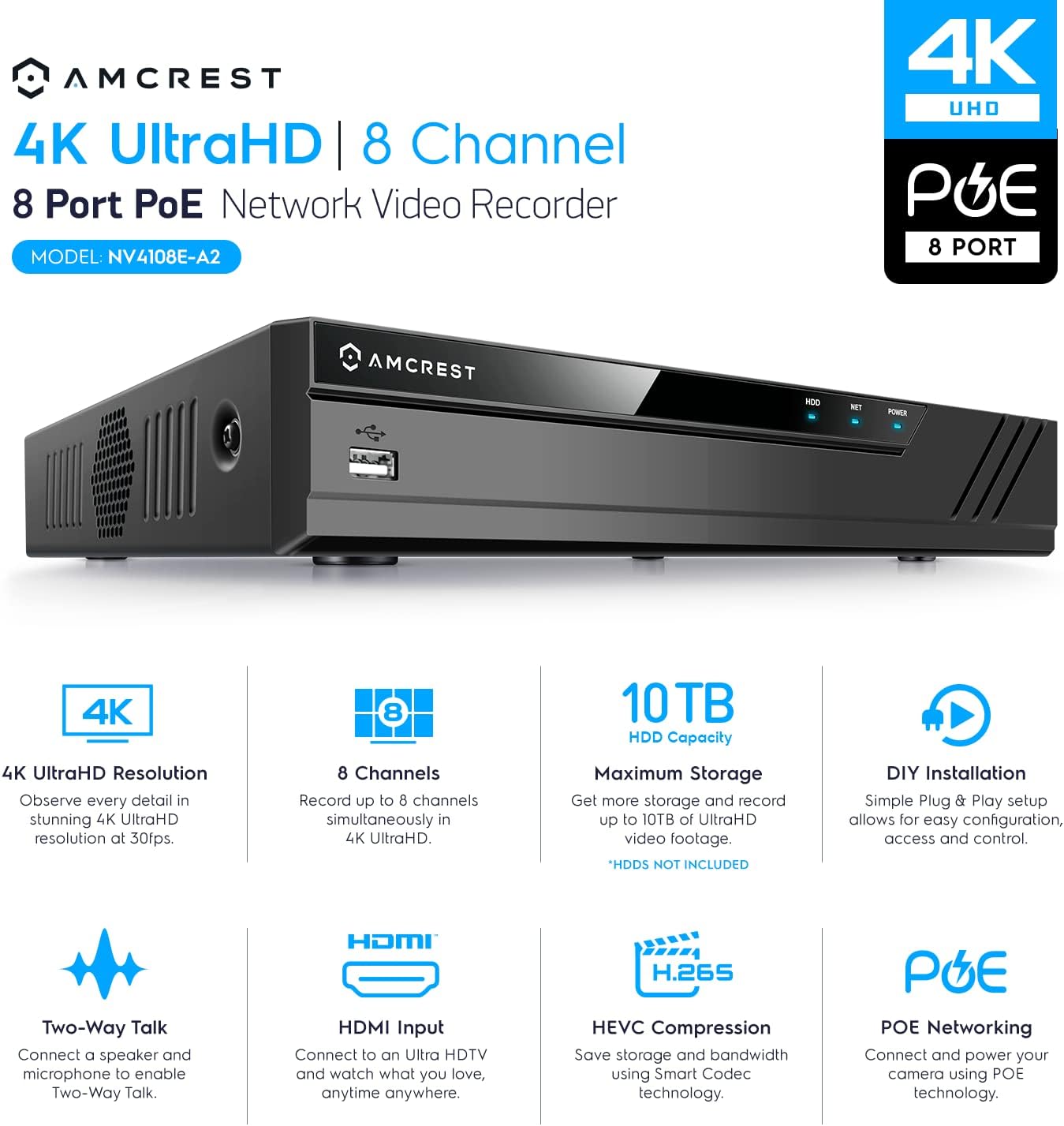
Amcrest
$129.99
In stock on Amazon
Check price on AmazonHybrid Recorder
A hybrid recorder accepts both coaxial analog inputs and IP camera streams simultaneously. On paper, it solves the retrofit problem neatly. In practice, as Security Sales & Integration’s Hybrid Recorders Explained documents, the compromise shows up in three consistent places: IP channel counts are typically capped lower than a pure NVR of equivalent cost, codec support for IP channels often lags behind dedicated NVR firmware, and some manufacturers charge a per-channel license fee to “unlock” additional IP inputs beyond the base allotment.
The hybrid makes sense in a narrow but real scenario: a client has functioning analog cameras with residual value, a limited budget, and a documented plan to phase in IP cameras over 24–36 months. If those three conditions aren’t all present, the math usually favors picking a lane rather than straddling both.
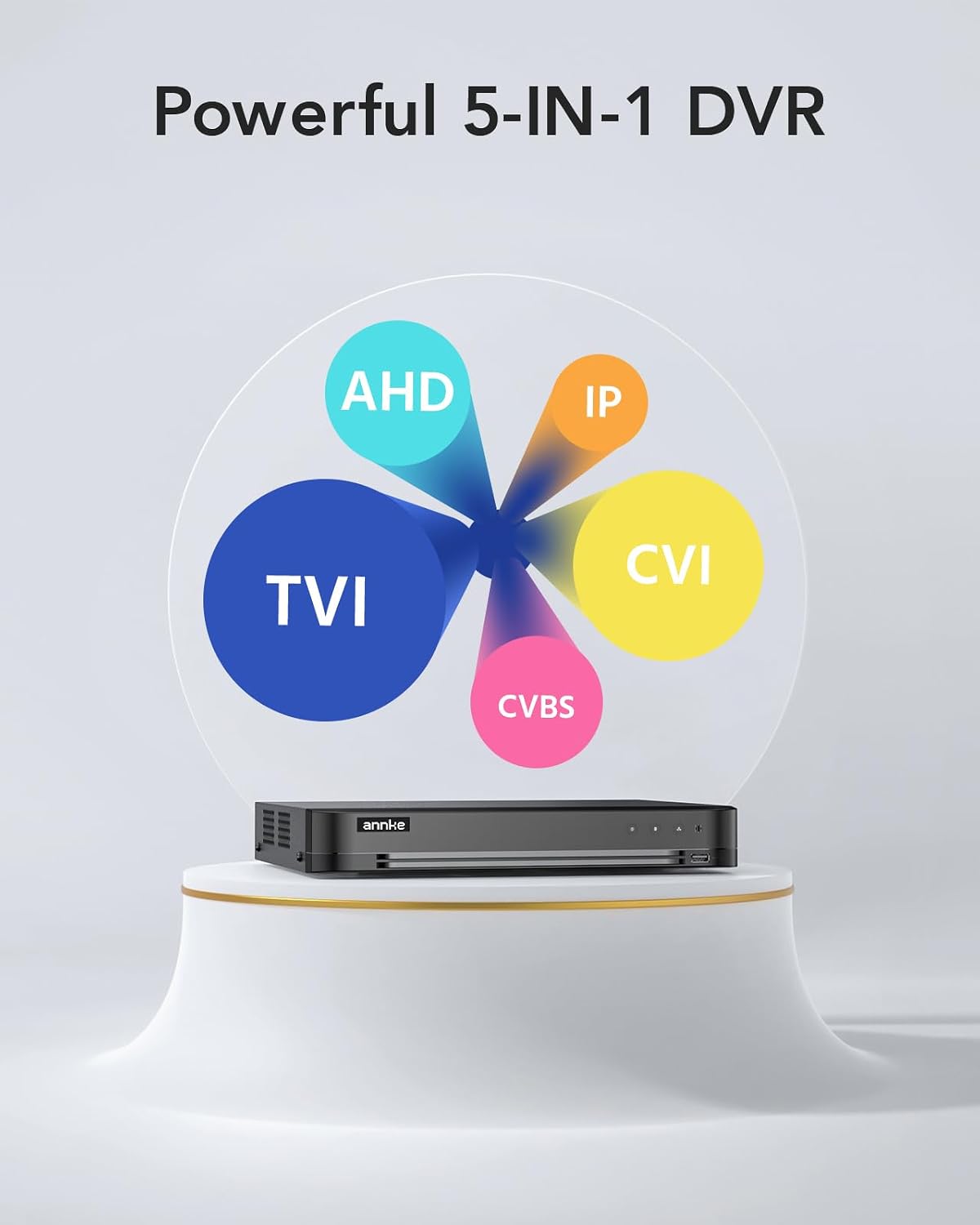
ANNKE TVI/AHD/CVI/CVBS/IPC
$172.99
In stock on Amazon
Check price on AmazonRunning the Numbers: Cost, Cabling, and Channel Math
Here’s where the decision crystallizes. Using a 16-channel deployment as the baseline makes the comparison concrete enough to drop directly into a quote.
16-channel deployment — 2026 street pricing estimates:
| Architecture | Recorder cost (est.) | Cabling cost/channel | Unlock fees |
|---|---|---|---|
| DVR (analog HD) | $180–$350 | $0.10–$0.20/ft coax | None |
| NVR (IP only) | $250–$600 | $0.08–$0.15/ft Cat6 + PoE switch | None (most brands) |
| Hybrid (8 analog + 8 IP config) | $300–$550 | Mixed — dual cabling budget required | Often $20–$50/IP channel |
Security Info Watch’s Analog HD vs IP Camera Market Trends report provides context on cabling cost ranges; recorder street pricing reflects aggregated distributor data current as of Q2 2026.
A few things jump out immediately. First, Cat6 and coax run roughly comparable costs per linear foot for the cable itself — coax typically pulls easier through existing conduit, which often tips retrofit jobs toward keeping analog runs intact rather than re-pulling. Second, that hybrid IP channel unlock fee is a line item that integrators frequently miss at the quoting stage. On a 16-channel hybrid with 8 IP channels at $40 per unlock, you’ve added $320 to the project cost that will never appear in the recorder’s MSRP or a distributor’s catalog page.
Third — and this number matters most for clients who expect to grow — NVR architecture scales differently than DVR architecture. Adding channels to a DVR often means adding a second DVR unit and a video management software (VMS) layer to tie them together into a unified interface. Adding channels on a well-specced NVR or IP-based VMS platform like Milestone XProtect or Genetec Security Center is a license key and a switch port. Asmag.com’s Video Surveillance Recorder Technology Trends 2025 report documents that IP camera shipments are outpacing analog camera shipments by more than 4:1 globally — a relevant supply-chain signal, because the longer a client stays on analog infrastructure, the harder it becomes to source replacement cameras and compatible DVR hardware at competitive pricing as the analog product lines thin out.
Where Each Architecture Still Wins in 2026
When to Stick With DVR
- The existing coaxial runs are in good physical condition and the client explicitly does not want a network-layer expansion added to the project scope.
- Budget is genuinely constrained below $500 total for the recorder, camera count is 4–8, and there are no analytics requirements anywhere in the spec.
- The physical environment makes IP networking impractical — outdoor agricultural installations, utility buildings with no data infrastructure, or legacy industrial environments where running Cat6 would require significant structural penetration work.
Property owners and facilities managers with established analog systems consistently report that a mid-tier DVR swap extends a functioning system’s useful life by three to five years without requiring a full camera replacement cycle. That is a real value proposition for clients who want to defer capital expenditure without losing surveillance coverage.
ANNKE
$62.99
In stock on Amazon
Check price on AmazonWhen to Go NVR
- This is a new-build or a site with existing structured cabling already run to camera locations.
- The client wants remote viewing, motion-triggered alerts, or any form of video analytics — license plate recognition, person detection, loitering alerts, or occupancy counting.
- Camera count is likely to expand beyond the initial deployment and scalability is an explicit priority.
- The spec sheet names IP-native brands such as Axis, Hanwha, Dahua, or Reolink — all of which are optimized for IP/NVR environments and offer limited or no analog variants.
PCMag’s security camera system reviews reinforce this consistently: for any installation expected to be current hardware in 2028, NVR is the default starting point, not a premium option.
Amcrest
$129.99
In stock on Amazon
Check price on AmazonWhen a Hybrid Makes Sense
- The client has 12 or more analog cameras in good working condition with three or more years of residual value remaining.
- The project adds a discrete new zone — a building wing addition, a parking expansion, a new access-controlled entry — that warrants IP cameras for better resolution or analytics.
- The budget cannot support a full rip-and-replace, and the decision-maker has approved a phased migration plan with defined milestones and a target end state.
- You have already calculated the per-channel IP unlock fees into the proposal and the hybrid still wins on total cost of ownership over the migration window.
One scenario where hybrid recorders are genuinely underrated: retail chains with mixed-vintage store footprints. Security Sales & Integration’s coverage of hybrid deployments in multi-site retail notes that hybrid systems allow corporate IT to standardize on a single VMS interface across all locations while individual stores at different upgrade stages continue running different camera types on the backend. That operational consistency — one monitoring interface regardless of which store you’re looking at — has real value for multi-site operators who would otherwise be managing three different systems from three different eras simultaneously.
ANNKE TVI/AHD/CVI/CVBS/IPC
$172.99
In stock on Amazon
Check price on AmazonCodec and Feature Parity: The Hidden Gap
This is the section that trips up practitioners at the six-to-eighteen-month experience mark most often, so it’s worth being direct about the mechanics.
When a DVR manufacturer states that their unit supports H.265 — the compression standard that roughly halves file size compared to H.264 for equivalent image quality — they almost always mean for new cameras purchased within the same manufacturer’s product family. Third-party analog cameras frequently default to H.264, and the DVR’s transcoding overhead increases accordingly. Storage estimates built on H.265 efficiency numbers will be wrong on mixed-brand analog deployments.
NVRs carry the same compatibility nuance. An NVR from a given manufacturer will decode H.265 streams from that brand’s own cameras cleanly and predictably. ONVIF-conformant cameras from other brands often connect, but IPVM’s documentation on ONVIF compatibility notes consistently that advanced features — two-way audio passthrough, on-camera event triggers, smart motion zones, and deep analytics — frequently fall back to basic functionality when mixing brands across a nominally “ONVIF-compliant” system. If a client’s specification requires deep analytics integration, a matched ecosystem (Axis cameras on Axis recorder hardware, Hanwha cameras on Wisenet Wave NVR) or an enterprise VMS is the architecturally safer choice.
Hybrid recorders present the most complex codec picture of all three options. The analog-side encoding is handled by the DVR chipset subsystem; the IP-side streams are managed by separate NVR firmware; and the two subsystems routinely run different default compression settings. Integrators who have deployed hybrids in long-run enterprise environments frequently report inconsistent storage consumption compared to pre-deployment projections, precisely because the two codec paths behave differently and most storage calculators assume a single uniform codec across all channels.
The Decision Framework
If your project is in scope right now, this is the framework:
Working analog cameras with more than two years of lifecycle remaining, budget ceiling below $600, no analytics requirements → DVR. Don’t over-engineer it. A solid 8- or 16-channel DVR from an established manufacturer will serve a straightforward surveillance need reliably for the remainder of the analog system’s life.
New-build site, existing network infrastructure, or any mention of analytics, remote access, or future expansion → NVR. This is the default choice for any installation expected to still be current hardware in 2028. The IP camera ecosystem’s depth and the VMS integration options available through NVR deployments are not replicable on analog.
Documented mixed camera inventory, phased budget, and an approved migration roadmap → Hybrid, with IP unlock fees explicitly line-itemed in the proposal. Get the per-channel IP unlock cost confirmed in writing from the distributor before the proposal goes out. That number is not always in the published spec sheet.
For enterprise multi-site deployments where Milestone XProtect Corporate or Genetec Security Center is already in the conversation, the recorder form factor is almost secondary. Those platforms abstract the hardware layer; what matters at that scale is network architecture, server failover design, and per-channel licensing cost. The DVR vs. NVR debate was effectively settled at the camera specification phase, not the recorder specification phase.
The recorder is not the hard part of this decision. The camera inventory is. Start there, and the right recorder architecture usually becomes obvious before you’ve opened a single product catalog.